1. What is dropshipping?
1.1 What is dropshipping?
Dropshipping is a business model where you sell products online without keeping them in stock.When a customer orders from your store, you buy the item from a supplier, who ships it directly to the customer.
1.2 How does dropshipping work?
1.3 What are dropshipping suppliers?
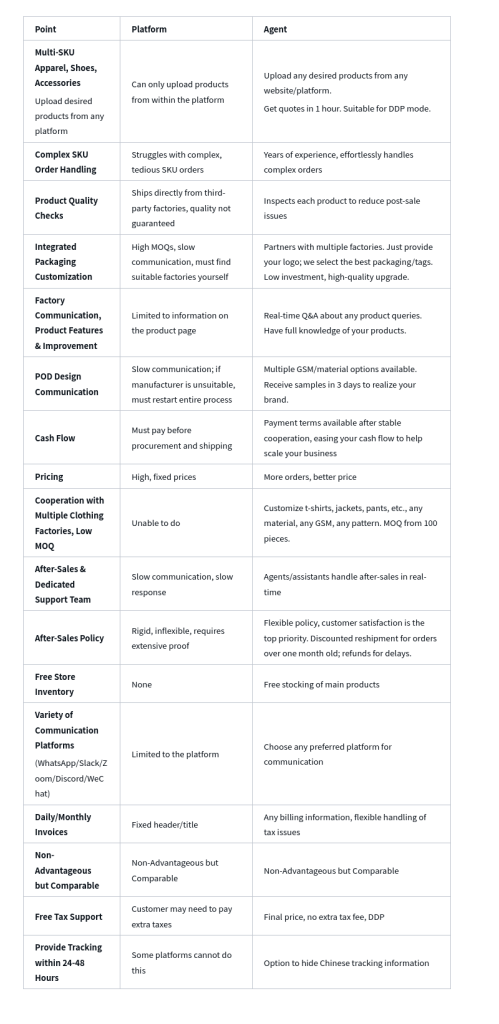
- Platform – They buy products or cooperate with manufacturers and sell them to you in smaller amounts. Prices are a bit higher, but they offer more variety.
- Agents or sourcing companies – They help you find good suppliers, check product quality, and manage orders for you. They make dropshipping easier and faster, but do not provide product selection.
2. Advantages of Dropshipping
- Low costs to start, test.
- Wide selection of products to sell.
- Easier to scale because no need to prepare stock in advanced.
3. Disadvantages of Dropshipping
1. Relatively low profit
Reason: Products will be shipped from China, so you must choose air transport for fast delivery.
2. Uncontrollable inventory and quality.
Reason: no inventory in advance, production and inventory Status is determined by the factory.
3. Uncontrollable shipping and long shipping times.
Reason: Packages will be shipped from China, the shipping time cannot be compared with local warehouses in Europe or the United States
4. Payment policies.
Reason:PayPal and Stripe have stricter audits on Dropshipping businesses, and the loan release time is usually longer than that of stores with actual inventory or local warehouses.
4. advantages and disadvantages of Platform
Advantages
1. Available product selection (prices displayed directly, product information is clear at one page, including all product skus, material and related picture, videos)
2. More trustworthy
3. Suitable for beginners
4. User-friendly, visual interface
Disadvantages:
1. Unable to process complex orders or bundle orders, especially clothing, shoes and jewelry stores.
2. After-sales service is handled by ticket, resulting in slow communication.
3. hard to customize products and package.
4. High prices, limited shipping options, and country restrictions.
6. Orders must be paid before processing.
5. Advantages and disadvantages of Agent
Advantages
1.Handles complex SKUs and quality checks in one warehouse.
2.Low and flexible prices with different shipping options.
3.Many shipping choices and custom order fulfillment detail. (whether to upload order numbers, hide Chinese process, obtain local tracking numbers)
4.Can get quote of product from any source.
5.Offers custom packaging and branding easily.
6.Fast and helpful after-sales support.
7.Supports print-on-demand (POD) products.
8.Customize invoice content when necessary
9.Access to the agent’s full Chinese business resources and supplier network, such as help with opening a Hong Kong company account.
Disadvantages
1. Unreliability
E7 Solution: 10-year-old company, 20K+followers in IG, providing signed contracts
2. Product Quote takes time
E7 Solution: 5 quoters feedback price on the same day
3. Shipping time can be long due to complex SKUs
E7 Solution: 50+ transport personnel and fully automated system ensure your products are shipped as soon as they arrive in the warehouse.
4. Unable to provide product list
E7 Solution:Cooperate with multiple manufacturers so that can recommend competitive new products
6. How to choose the right supplier, and when do you need an agent?
1. Product Nature (Multi-product vs. Single Product)
- For complex SKUs such as clothing or jewelry stores:
Use platform + agent. Select products through the platform, and let the agent handle complex orders.
- For single-SKU stores or confirmed winning products (for example, health or electronics):
Use agent only. The agent can ensure better quality control, negotiable prices, and more stability.
2. Order Quantity
- Startup / Testing Stage:
Choose a platform. It’s low cost, easy to use, and supports automation.
- Stable Daily Orders / Winning Product Stage:
Choose an agent. It provides stable supply, lower cost, and customization (product and packaging).
- Brand Expansion Stage:
Use agent or agent + overseas warehouse. This improves delivery time and overall customer experience.
3. Development Route
- Testing Store → Platform
- Optimized / Niche Store → Agent
- Brand Store → Agent + Overseas Warehouse
4. Store Level (Newbie to Brand Owner)
- Stage 1: New Seller (Testing Stage) → General Store / Testing Store / Platform
- Stage 2: Product Validation Stage → Niche Store / Optimized Store / Independent Site
- Stage 3: Brand Growth Stage → One Product Store / Brand Store / Agent Partnership
5. Seller Development Path
- New Sellers:
Use a platform. It’s easy to automate and helps you test products quickly.
- Sellers with marketing experience but not yet profitable:
Use a platform first to find a winning product.
If you can’t make profit, the issue is likely marketing—not the supplier.
- Sellers who are already profitable and want to scale:
Use an agent to reduce costs and customize packaging to improve repeat purchases.
- Brand Owners:
Already working with an agent. At this stage, choose agents with better service or move to overseas warehouses for faster delivery and brand growth.
If you focus on → automation, easy operation, and testing many products → choose a platform.
If you focus on → cost control, branding, stability, and higher profit margins → choose an agent.

7. Summary